Alcatraz rewards chronological attention. If the visit begins and ends with celebrity prisoners, the island becomes a stage set. If it is read as a changing federal landscape in San Francisco Bay, the Cellhouse becomes one structure within a much larger argument about power, isolation and who controls public land.
Layer 1: an island in an Indigenous homeland
Alcatraz sits within the homelands and continuing cultural world of Indigenous peoples of the Bay Area, including the Ohlone. Written federal and Spanish colonial records do not define the beginning of the island’s history. A responsible account starts by recognizing that European mapping and U.S. military construction entered an already inhabited regional landscape.
The Spanish name associated with seabirds eventually became “Alcatraz,” but translation and the exact island originally identified are more complicated than a neat origin story suggests. The safer lesson is that colonial naming reframed a place through an outsider’s chart.
Layer 2: fort and lighthouse
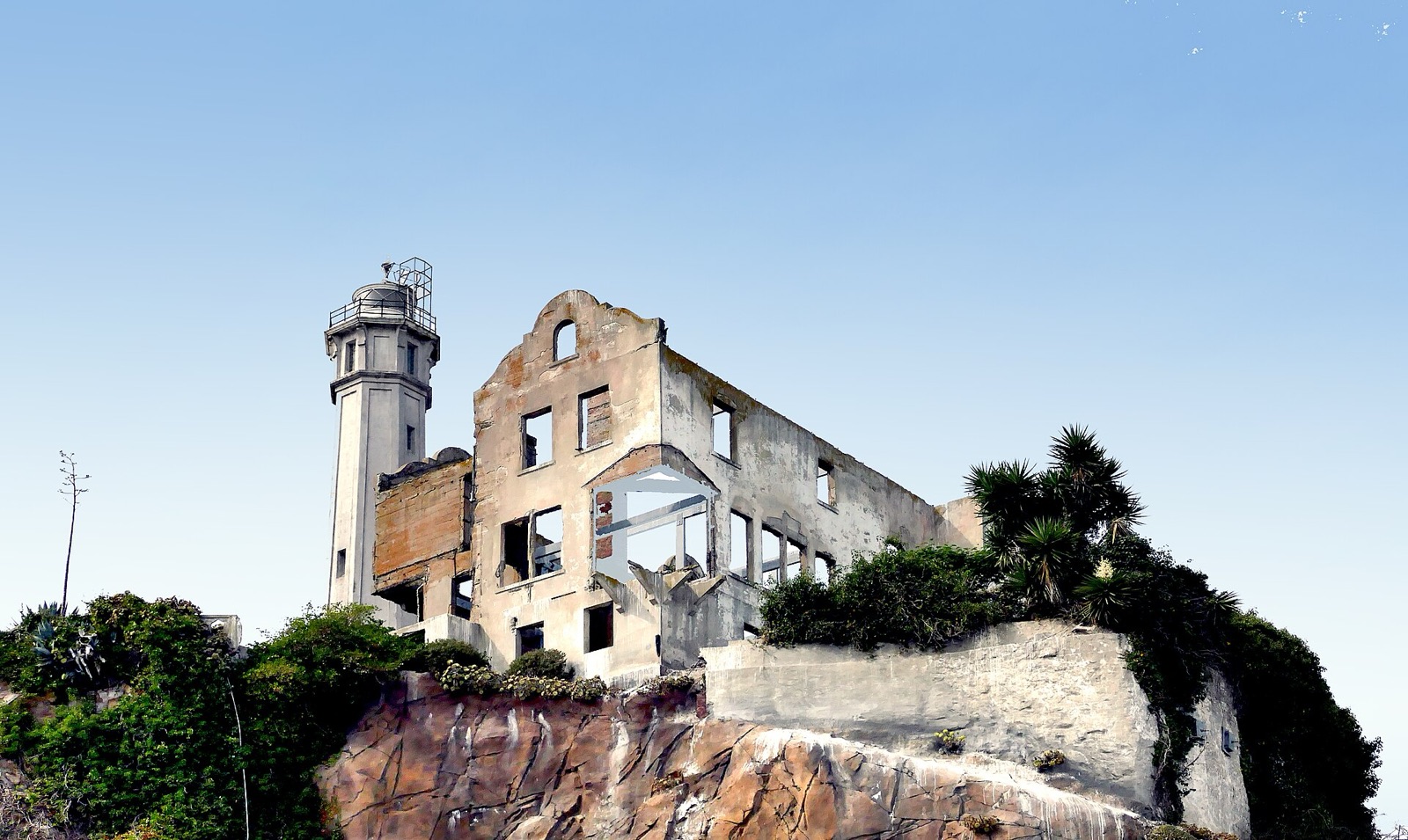
After California became part of the United States, the federal government reserved Alcatraz for military purposes. In the 1850s, fortifications and artillery were developed to protect the entrance to San Francisco Bay during the Gold Rush era. A lighthouse began operating in 1854; the National Park Service identifies it as the first lighthouse built on the U.S. West Coast.
The fort’s strategic value changed as weapons technology advanced. Yet the built island remained useful to the Army. Roads, defensive structures, housing and service systems created the physical base that later institutions reused.
Layer 3: military confinement
Alcatraz developed into a military prison during the nineteenth century. Its prisoners included military offenders and people caught in the expanding machinery of U.S. power. The NPS history includes the confinement of Hopi men who resisted federal policies intended to force cultural assimilation. That history makes clear that imprisonment on Alcatraz did not begin in 1934 and cannot be separated from wider federal policy.
By the early twentieth century, a large concrete cell building had transformed the island’s skyline. This military prison infrastructure would later be adapted by the Department of Justice.
Layer 4: federal penitentiary, 1934–1963
The federal penitentiary opened in 1934 as a high-security institution for prisoners the government considered difficult to manage elsewhere. Its reputation depended on restricted communication, controlled routine and physical separation. The bay did not make escape literally impossible, but cold water, currents, distance and surveillance were powerful barriers.
Famous names attract attention, yet the daily system is the more revealing subject: counts, work assignments, meals, silence, recreation, correspondence and discipline. Officers and their families also lived on the island, producing a civilian community beside the prison. The institution closed in 1963 after operational costs and deteriorating facilities made continuation impractical.
“The Rock” was not only a building for exceptional prisoners. It was a designed routine imposed every day.
Layer 5: occupation, park and public memory
From November 1969 to June 1971, Indians of All Tribes occupied Alcatraz. The action asserted Indigenous rights, challenged federal policy and created an influential platform for modern Native activism. Painted messages remain among the island’s most important historic resources. They are not graffiti to be cleaned away or a footnote after the prison story.
Alcatraz became part of Golden Gate National Recreation Area in 1972. Under National Park Service management, it opened to public visitation and developed as a place where historic structures, oral histories, cultural meaning and natural resources meet. Preservation does not freeze the island at one date: ruins weather, gardens are restored, bird colonies reshape access and historical interpretation evolves.
A field method for the visit
At each major structure, ask three questions. Who built or used this? A military road, prison apartment and occupation message come from different authorities and experiences. What survives? A ruin may show fire and weather while a reconstructed room communicates selected evidence. Whose voice is present? Official documents, incarcerated people, correctional staff, family members and Indigenous activists do not tell one identical story.
| Layer | Visible clues | Question to carry |
|---|---|---|
| Military | Roads, defensive works, lighthouse | How did the bay shape federal strategy? |
| Military prison | Early confinement infrastructure | Who was confined before 1934, and why? |
| Federal prison | Cellhouse, industries, administration | How did routine produce control? |
| Occupation | Painted words and interpreted sites | Why did activists choose this federal island? |
| National park | Preservation, programs, wildlife closures | How is public memory managed today? |
What not to flatten
Do not treat every ruin as a prison ruin or every painted word as prison-era graffiti. Do not let escape legends eclipse thousands of ordinary days. And do not describe the occupation in the past tense as if Indigenous presence and political questions ended when federal marshals removed the remaining occupiers.