The occupation began on November 20, 1969, when a group of Native activists landed on Alcatraz and claimed the island in the name of Indians of All Tribes. It continued until June 11, 1971. Those dates describe the action; they do not contain its meaning. The occupation emerged from generations of dispossession and from contemporary federal policies that pressured Native people to leave homelands, relocate to cities and surrender tribal status.
Why an abandoned federal island?
The federal penitentiary had closed in 1963, leaving Alcatraz symbolically powerful and physically underused. Activists drew on the history of federal treaties and land policy to argue that unused federal land should return to Native people. Their public claim used irony, offering to purchase the island under terms that echoed the undervaluation of Indigenous lands.
Alcatraz was visible from San Francisco and close to national media. It also embodied federal authority: military control, imprisonment and abandonment. Occupying it turned a symbol of confinement into a place from which Native people could speak publicly.
The proposal was constructive
The occupiers did not present only a protest against the past. Their plans included an Indigenous cultural center, educational facilities, a spiritual center and a museum. These ideas addressed the need for Native-led institutions in an urban region shaped by federal relocation programs.
Students and organizers helped create a functioning community. Donations arrived from supporters; boats carried people and supplies; radio broadcasts shared news. Leadership and population changed over time, and participants came from many tribal nations and personal backgrounds. “Indians of All Tribes” expressed unity without erasing those distinct identities.
Richard Oakes and collective leadership
Richard Oakes, a Mohawk activist, became a prominent spokesperson during the occupation’s early period. His visibility matters, but the action was not the work of one man. Women organized daily life, communications, education and political strategy; families and children were part of the community. A responsible account looks for many voices rather than a single heroic biography.
Oakes left after the accidental death of his stepdaughter on the island. The tragedy and his departure changed the occupation. Over time, declining resources, internal tensions, fire damage and federal pressure made daily life more difficult.
The federal removal did not end the impact
Federal authorities removed the remaining occupiers in June 1971. Judged only by control of the land, the occupation ended without its proposed university or cultural center. Judged by political influence, its reach was much larger. It energized Native activism, connected organizers and helped shift public debate during a period when federal Indian policy was moving away from termination and toward greater tribal self-determination.
Alcatraz inspired later actions and remains a reference point in Indigenous political history. Annual commemorative gatherings, including the Indigenous Peoples Sunrise Gathering, connect the island to living communities. Visitors must check current official information for any public program rather than treating a recurring tradition as a guaranteed event.
Read the painted words as primary evidence
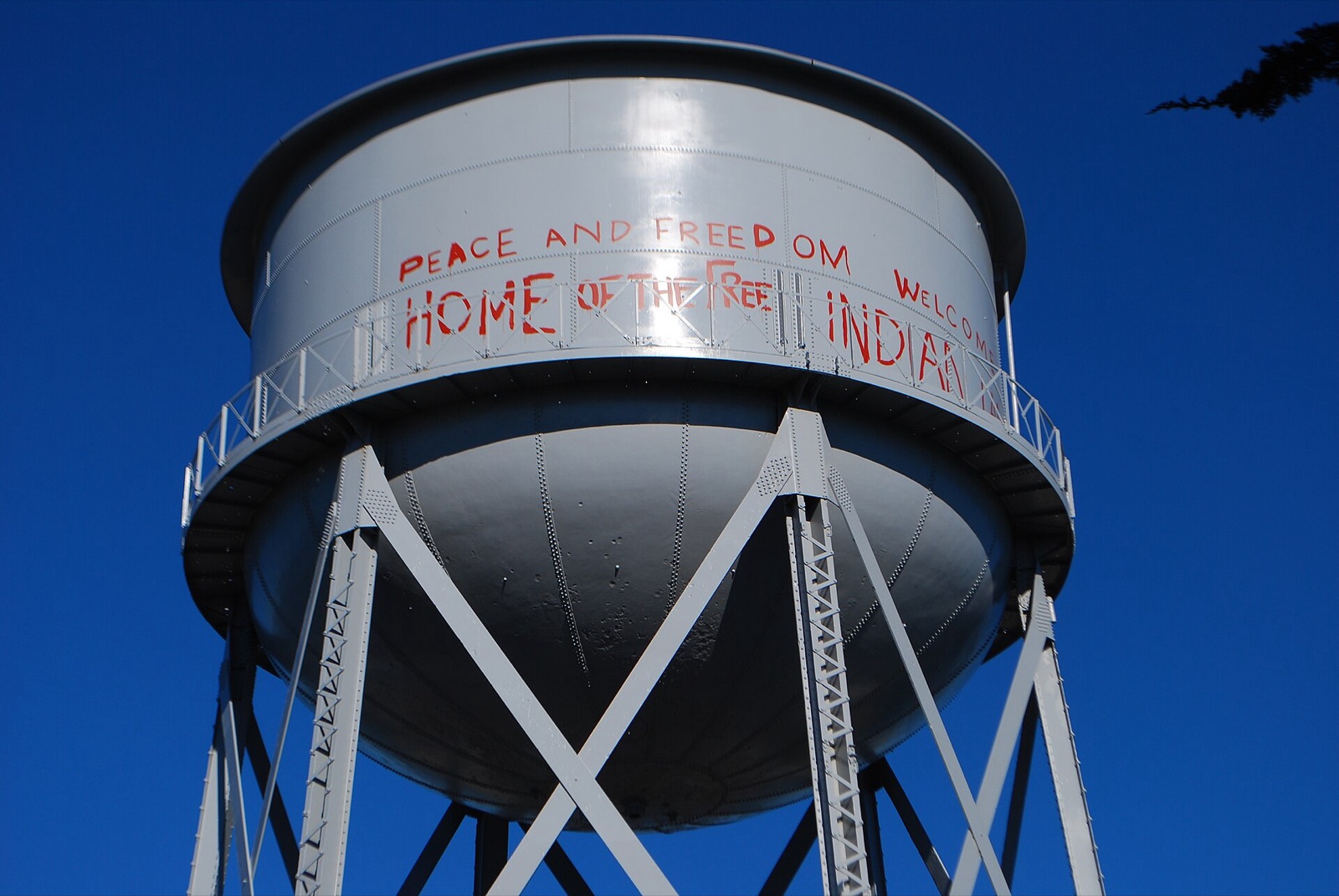
Messages on buildings and the water tower interrupt the prison landscape. Their placement matters: they rename arrival points, assert ownership and claim visibility over federal architecture. Weathering is part of their material history, while conservation raises difficult questions about preserving an activist mark without turning it into decoration.
The occupation did not add a new story to the edge of Alcatraz. It challenged who had the authority to tell every earlier story.
A respectful visitor practice
Do not touch, trace, climb toward or add to historic markings. Avoid captions that describe them simply as “graffiti” without identifying the occupation. Photograph the message and its architectural context, then read the NPS interpretation or oral-history material linked on our Sources page.
Use specific language: “Indians of All Tribes occupied Alcatraz from 1969 to 1971.” “Native Americans took over the prison” is less precise because the prison had already closed, the coalition named itself, and the action pursued defined political and cultural aims.
Questions worth carrying
- Why did an abandoned federal property become a compelling land claim?
- How did relocation policies shape the Bay Area Native community?
- What institutions did the occupiers want to build?
- Whose work disappears when the history focuses on one spokesperson?
- How should a national park preserve an unfinished political statement?
- What does continuing Indigenous presence change about the island today?